Committed to care
Safety is the silent foundation of every descent.
We don't treat safety as a set of constraints. It's the medium through which true freedom in the water is reached — calm, prepared, and never alone.
Medical screening
We read your form before you touch the water.
Freediving is a deeply physical practice. Before you join us in Cala Gonone, we ask for a short medical self-assessment — and for some conditions, a doctor's clearance.
Start the booking & medical form-
Ears & sinuses
Equalization is everything below the surface. Tell us about ear surgery, perforations, or chronic sinus trouble.
-
Respiratory health
Asthma and lung conditions change how we plan your dives. They rarely rule you out — but we need to know.
-
Cardiovascular system
Heart conditions and blood pressure are the screening's first priority. Some need a physician's sign-off before the water.
-
Recent dives & flights
Scuba in the last 24 hours, or a flight either side of your course, both matter to how we schedule you.
The golden rule
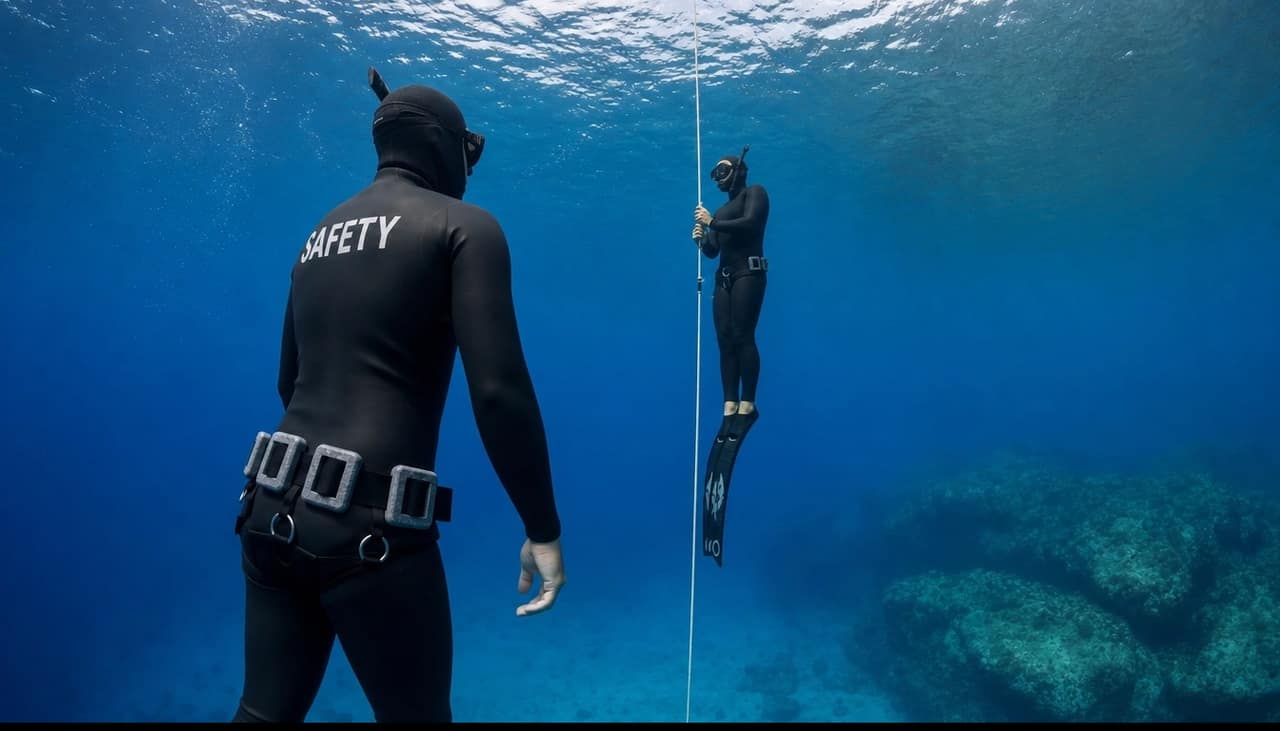
Never dive alone.
We hold to the strictest global safety standards: a trained buddy watching every breath-hold, and every meter accounted for.
Small groups
We limit course sizes so attention and contact stay constant.
One-to-one on the line
On the deep dives, an instructor meets you on the way up — every time.
Oxygen & gear
Emergency oxygen and specialized safety kit are present on every excursion.
Frequently asked.
Do I need to be a strong swimmer? +
You need to be comfortable in deep water and able to swim a couple of laps without panic. You don't need to be fast. Freediving is about relaxation, not athletic swimming, and the technique does the work.
How long can you actually hold your breath? +
Less than you'd think to start, more than you'd believe within two days. First Breath students routinely double their breath-hold by the end of the course once they stop fighting it. It's learned, not inherited.
Is there a medical form, and why? +
Yes, and it's not a formality. Pressure changes affect your sinuses, ears, and lungs. We need to know about ear surgery, asthma, heart conditions, and recent dives before you get in the water. Some conditions need a doctor's clearance first.
What's the water like, and do I need a wetsuit? +
Clear, calm, and between 18 and 26 degrees depending on the month. We provide wetsuits, masks, fins, and weights in your size. You bring a swimsuit and a towel.
Can I fly after a freediving course? +
Wait at least 12 hours after your last dives before flying, and longer after the deeper courses. We'll tell you exactly based on your final day so you can plan your travel.
What if I get to the cove and decide it's not for me? +
That happens, and it's fine. If you call it before the first descent we'll move you to theory and a shallow session instead, no pressure to go deep. Safety always wins over the certificate.